
Everyone who grew up near an arcade has a first coin story. Maybe it was a maze that chimed with every dot you ate, or a cabinet with a crowd behind it and three letters at the top of the screen that nobody could beat. Classic arcade games still pull people in that way, decades later, because a good one makes sense in about five seconds and takes years to master.
Call them old school arcade games or classic retro arcade games: this guide ranks 16 of the best classic arcade games of all time by influence and by how much fun they are to play today. Each entry gives the release year, the maker, what made the game great and how to play it. You will also find a table for choosing your first game, high-score tips and a few notes on arcade manners. When you finish, see where to find vintage arcade games near you.
Quick Answer
The best classic arcade games of all time are Pac-Man (1980), Space Invaders (1978), Donkey Kong (1981), Street Fighter II (1991) and Galaga (1981). Each one changed what an arcade game could be, and each is still easy to learn and hard to master. The full ranking runs from Pong to Teenage Mutant Ninja Turtles.
- How we ranked: by influence on later games and by how fun the game still feels, not by decade.
- Easiest to start: Pong, Frogger and Pac-Man need no instructions.
- Best for two players: Joust, Street Fighter II and Pong.
- Best for a group of four: Teenage Mutant Ninja Turtles.
- Best for high-score chasing: Galaga, Asteroids and Centipede.
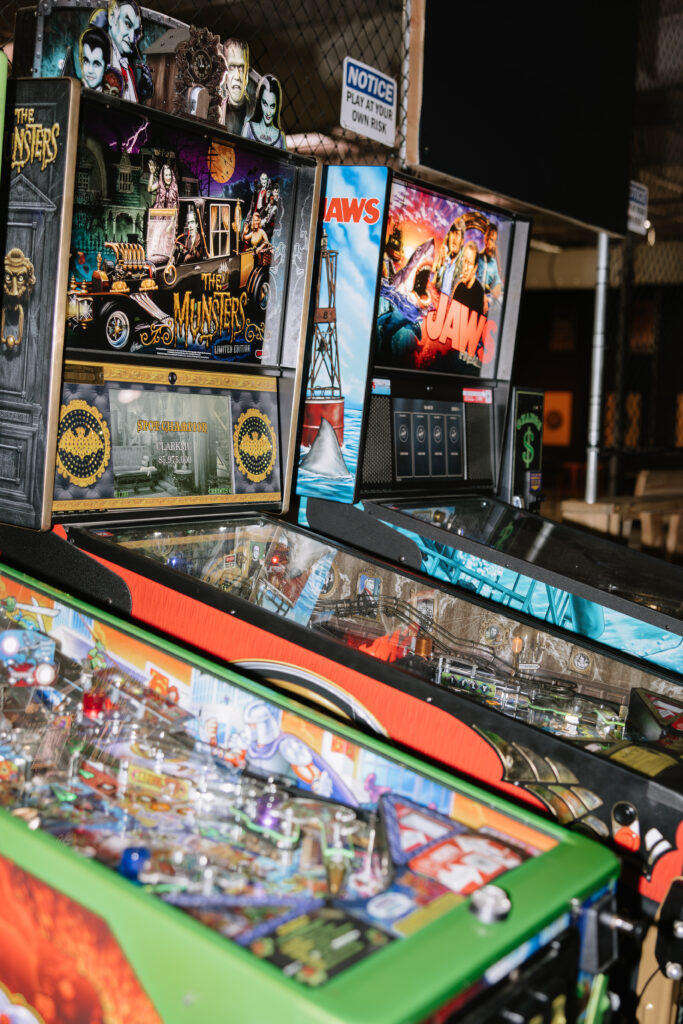
- Where to play near you: Rec Hall in St. Charles, Missouri has skee-ball and pinball on its arcade floor, and the floor changes, so call to ask what is out today.
Here is a quick reference table.
| If you want | Start with | Why |
|---|---|---|
| The most famous game | Pac-Man | Simple rules and a character everyone knows |
| A game with no learning curve | Pong | Two paddles and a ball |
| A head-to-head match | Street Fighter II | A second player can join at any time |
| A team game for four | Teenage Mutant Ninja Turtles | Four players fight side by side |
| A high score to brag about | Galaga | Short rounds and clear goals |
| Something quirky | Dig Dug | You inflate enemies with an air pump |
Want to see an arcade in person? Visit the Rec Hall retro arcade floor in St. Charles.
What Is a Classic Arcade Game?
A classic arcade game is a coin-operated video game from the golden age of arcades, which ran from the late 1970s to the early 1980s, or from the fighting game boom that followed in the early 1990s. These games use dedicated cabinets and controls, short rounds, rising difficulty and a high score to chase. Newer retro style arcade games copy the look, but the originals come from these years.
What Is an Arcade Game?
An arcade game is a game played on a coin-operated machine in a public place such as an arcade, a bar or an entertainment venue. You pay for each play and try to last as long as you can or score as high as you can. This list focuses on classic arcade video games.
How Do Arcade Games Work?
You add a coin or credit and the machine gives you a set number of lives. The game then gets harder with each round until your lives run out. Space Invaders helped set this pattern in 1978 with multiple lives, rising difficulty and a saved high score.
How Did We Rank These Games?
We used four simple questions for every game:
- Influence: did it change how later games were made?
- Playability: can a new player enjoy it in the first minute?
- Depth: does it reward practice over many visits?
- Social energy: does it make people gather and cheer?
What Are the Best Classic Arcade Games of All Time?
The best classic arcade games of all time are Pac-Man, Space Invaders, Donkey Kong, Street Fighter II and Galaga, followed by eleven more that shaped the arcade. Every game below includes the year it was released, the company that made it and a short guide to how it plays. This table shows the full ranking at a glance.
| Rank | Game | Year | Maker | Best for |
|---|---|---|---|---|
| 1 | Pac-Man | 1980 | Namco | Anyone |
| 2 | Space Invaders | 1978 | Taito | High-score chasers |
| 3 | Donkey Kong | 1981 | Nintendo | Solo challenge |
| 4 | Street Fighter II | 1991 | Capcom | Two players |
| 5 | Galaga | 1981 | Namco | Quick sessions |
| 6 | Ms. Pac-Man | 1982 | General Computer Corporation and Midway | Maze fans |
| 7 | Asteroids | 1979 | Atari | Spaceship fans |
| 8 | Pong | 1972 | Atari | Total beginners |
| 9 | Frogger | 1981 | Konami | Quick laughs |
| 10 | Defender | 1981 | Williams Electronics | Skilled players |
| 11 | Centipede | 1981 | Atari | Trackball fans |
| 12 | Joust | 1982 | Williams Electronics | Two players |
| 13 | Dig Dug | 1982 | Namco | Something different |
| 14 | Missile Command | 1980 | Atari | Tense strategy |
| 15 | Q*bert | 1982 | Gottlieb | Puzzle fans |
| 16 | Teenage Mutant Ninja Turtles | 1989 | Konami | Groups of four |
1. Pac-Man (1980, Namco)
Pac-Man is one of the most recognized classic arcade games ever made, and it ranks first because it reached people who never played video games. Designer Toru Iwatani wanted a game that appealed to women as well as men, so he made it cute and colorful. The four ghosts each chase you differently, which makes the maze feel alive. Japan saw it in May 1980 and North America in October.
How to play: steer Pac-Man through the maze and eat every dot while dodging the four ghosts. Eat a power pellet and the ghosts turn blue, so you can chase them for bonus points. Level 256 breaks because of a bug called a kill screen.
2. Space Invaders (1978, Taito)
Space Invaders started the golden age of arcades. Designer Tomohiro Nishikado built the game and its custom hardware himself, and it was the first fixed shooter and the first video game with endless rounds. The aliens and the music speed up as you shoot them, which builds a racing pulse. It also saved a high score, so every visit came with a number to beat.
How to play: slide your laser cannon left and right and shoot the descending aliens. Hide behind the bunkers, but know the aliens chew them away. Hit the mystery ship for bonus points. The game ends if the aliens reach the bottom.
3. Donkey Kong (1981, Nintendo)
Donkey Kong gave the world Mario, who appeared here as a carpenter often called Jumpman. Shigeru Miyamoto, working on his first video game, designed it alongside Gunpei Yokoi. It was among the first games to feature jumping and to tell a story with cutscenes. Clearing the first screen still feels like an achievement.
How to play: run, jump and climb ladders up the construction site to rescue Pauline from the giant ape. Jump the barrels and fireballs on the way, and time each leap.
4. Street Fighter II (1991, Capcom)
Street Fighter II moved the arcade from personal best scores to face-to-face matches. It brought six attack buttons, special moves, combos and fighters with their own styles. A second player can join a one-player game and challenge the person at the controls, so strangers became rivals in seconds. Its tournaments grew into the Evolution Championship Series, known as EVO.
How to play: pick a fighter, then use the joystick and six buttons to punch, kick and pull off special moves. Drain your opponent’s health bar to win a round, and win two rounds to win the match.
5. Galaga (1981, Namco)
Galaga turned the space shooter into a game of risk and reward. Shigeru Yokoyama led the team behind this sequel to Galaxian. Its best idea is the Boss Galaga, which can capture your ship with a tractor beam. Rescue that ship and you fly two at once with more firepower.
How to play: move your ship along the bottom and shoot aliens as they swoop in. Shoot a Boss Galaga as it dives with your captured ship to get it back. The third stage and every fourth stage after it is a bonus round.
6. Ms. Pac-Man (1982, General Computer Corporation and Midway)
Ms. Pac-Man began as a modification kit called Crazy Otto, and Midway turned it into an official sequel that many critics call the better game. It has four mazes, moving bonus fruit and ghosts that move semi-randomly, so you cannot win by memorizing one route. She was also a female lead in a hit arcade game.
How to play: the goal matches Pac-Man, but you must watch the ghosts instead of following a pattern. Use the warp tunnels and grab the bouncing fruit.
7. Asteroids (1979, Atari)
Asteroids sold more than 55,000 cabinets and showed what glowing vector graphics could do. Lyle Rains and Ed Logg designed it, and your ship keeps drifting after you stop thrusting. It was one of the first arcade games to let players enter their initials with a high score. Seeing your three letters on the board felt like a small victory.
How to play: rotate your triangular ship, thrust and fire to break each rock into smaller, faster pieces. Objects wrap around the screen edges. Use hyperspace as a last resort, because it can land you on a rock. After 40,000 points only the small saucer appears, and its aim improves as your score grows.
8. Pong (1972, Atari)
Pong was the first commercially successful video game, and it is part of the Smithsonian collection. Atari engineer Allan Alcorn made it as a warm-up exercise, and it turned into a hit. He split the paddle into eight segments so each part returns the ball at a different angle, and the ball speeds up the longer a point lasts.
How to play: turn your dial to move your paddle up and down and bounce the ball back to your opponent. Miss it and they score. The first player to reach eleven points wins.
9. Frogger (1981, Konami)
Frogger proved that an arcade game did not need weapons. Konami built a game about crossing a busy road and a river, with no fighting or shooting at all. The many ways your frog can fail make people laugh and try again, and it is easy to play with a friend shouting advice.
How to play: hop your frog across lanes of traffic, then ride logs and turtles across the river to reach one of five frog homes. You have 30 seconds per frog.
10. Defender (1981, Williams Electronics)
Defender is the game that made skilled players feel like experts. Eugene Jarvis led the design as his first video game project, and it created the horizontally scrolling shooter. It uses a joystick plus five buttons and is often named one of the hardest games ever made. Williams sold more than 55,000 units.
How to play: fly your ship left or right over a planet and shoot the alien landers before they carry astronauts away. Smart bombs wipe out every visible enemy, and hyperspace is a risky escape. Catch any astronaut who falls.
11. Centipede (1981, Atari)
Centipede was designed by Dona Bailey and Ed Logg, and it was one of the first arcade games played by many women and girls. The trackball feels smooth and fast under your palm. A winding centipede crawls through a field of mushrooms, and every shot you fire changes the board.
How to play: roll the trackball to move your Bug Blaster around the bottom of the screen and shoot the centipede. Each segment you hit turns into a mushroom, and a hit in the middle splits the centipede in two. Shooting the head scores the most points.
12. Joust (1982, Williams Electronics)
Joust is the most charming idea on this list: knights on flying ostriches bump lances in midair. Designer John Newcomer wanted a flying game without a space theme, and he built it for two players who can team up or compete. That mix of teamwork and teasing rivalry suits friends sharing one cabinet.
How to play: use the joystick to steer left and right and tap the button to flap your wings. Collide with an enemy knight and the one with the higher lance wins. Collect the eggs defeated knights leave behind.
13. Dig Dug (1982, Namco)
Dig Dug is the oddest and most original game in this ranking. Namco marketed it as a strategic digging game, and you beat enemies by pumping them up until they burst or dropping a rock on them. Masahisa Ikegami planned it with help from Galaga creator Shigeru Yokoyama.
How to play: dig tunnels through the dirt and use your air pump on the red Pookas and the fire-breathing Fygars, or loosen a rock above them. Clear every enemy to move on.
14. Missile Command (1980, Atari)
Missile Command put you in charge of defending six cities, and it arrived during the Cold War, so the tension felt real. Dave Theurer designed it and made Tempest the following year. The trackball lets you aim fast, and every shot is a small decision.
How to play: move the crosshair with the trackball and press one of three buttons to launch a counter-missile. Each base holds ten missiles, and the center base fires faster. Keep your cities alive as long as you can.
15. Q*bert (1982, Gottlieb)
Q*bert is a puzzle disguised as an action game. Warren Davis and Jeff Lee created the hopping hero and his pseudo-3D pyramid. When he is hit, a speech bubble full of symbols pops up that looks like swearing, and players still laugh about it.
How to play: hop diagonally across a pyramid of 28 cubes. Each landing changes a cube’s color, and you advance when every cube matches the target color. Avoid enemies such as the purple snake Coily, and never hop off the edge.
16. Teenage Mutant Ninja Turtles (1989, Konami)
Teenage Mutant Ninja Turtles showed what happens when four friends play together. Konami built a cartoon beat-em-up for four players, so a whole group could take on the Foot Clan at once. It captures the loud, shared energy of the arcade and is a great reason to bring a crew.
How to play: each player picks a turtle, and the team moves through the city, fighting enemies and clearing levels. Shredder has taken April and Splinter, and your job is to get them back.
What Other Retro Arcade Games Are Worth Playing?
Many retro arcade games just missed the top 16 and still deserve a coin. These popular arcade games come from the same golden age and the years after it:
- Galaxian (1979, Namco): the predecessor to Galaga, with dive-bombing aliens in bright colors.
- Tempest (1981, Atari): a shooter set on tunnel-like levels, among the first with a color vector display.
- Robotron 2084 (1982, Williams Electronics): a fast shooter that made two-joystick controls popular.
- Pole Position (1982, Namco): a racing game from just behind the car.
- Dragon’s Lair (1983, Cinematronics): a laserdisc game that looks like a cartoon movie.
- Golden Axe (1989, Sega): a fantasy brawler with three heroes and magic.
- NBA Jam (1993, Midway): two-on-two basketball that is loud, silly and built for pairs.
Which Old Arcade Games Should You Play First?
The best first arcade classic depends on your group and your mood. Pick Pong or Frogger for a quick laugh, Street Fighter II or Joust for two players, Teenage Mutant Ninja Turtles for four and Galaga or Asteroids for a solo high score. This table helps you choose.
| Your situation | Try this | Why it works |
|---|---|---|
| You have never played an arcade game | Pong or Pac-Man | The goal is clear in seconds |
| You have five minutes | Galaga | Rounds are short and fast |
| Two friends want a rivalry | Street Fighter II | Head-to-head, best two out of three rounds |
| Two friends want to team up | Joust | Cooperative or competitive, your choice |
| A group of four | Teenage Mutant Ninja Turtles | Everyone plays at once |
| You like thinking more than twitching | Q*bert | Planning beats reflexes |
| You want a real test | Defender | One of the toughest classics |
Looking for more two-person fun? Our date night ideas in St. Charles, MO pair well with a few rounds of Joust or Pong.
What Controls Do Classic Arcade Machines Use?
Classic arcade machines use the controls that fit each game: a joystick, buttons, a dial or a trackball. Because the cabinet and the game were built together, the controls feel different from a modern controller.
| Control | Games on this list | What it feels like |
|---|---|---|
| Joystick and one button | Frogger, Joust, Q*bert | Quick taps and simple moves |
| Joystick and many buttons | Street Fighter II (six buttons), Defender (five buttons) | Takes a few rounds to learn |
| Trackball | Centipede, Missile Command | Smooth, fast aiming with your palm |
| Rotate, thrust and fire buttons | Asteroids | Spaceship physics with drift |
| Dial | Pong | Turn to slide the paddle |
Why Were Classic Arcade Games So Hard?
Classic arcade games were hard because games had to stay short. Designers raised the difficulty round by round, and some added threats that punished slow play. Berzerk (Stern Electronics, 1980) sent an indestructible enemy after players who lingered too long.
That design is also why wins feel so good. You are not beating the game forever. You are beating your own best run. Pac-Man shows the extreme case: the ghosts get faster, and the 256th level breaks, so every player eventually meets a wall.
How Do You Get a High Score on Arcade Classics?
The fastest way to improve at arcade classics is to learn how the game behaves, not to react faster. Watch the enemies for a full round, find the pattern, and change one thing each try. These tips are practical suggestions, not official rules:
- Learn the ghosts: in Pac-Man, each ghost chases differently, so stop treating them as one threat.
- Rescue your ship: in Galaga, getting a captured fighter back gives you more firepower.
- Respect the saucers: in Asteroids, the small saucer aims better as your score grows.
- Spend your smart bombs wisely: in Defender, save them for the moment the screen fills up.
- Plan your shots: in Missile Command, you have a limited number of missiles per base.
- Watch an expert first: one minute behind a strong player teaches more than five lost lives.
What Are the Unwritten Rules of Arcade Manners?
Arcade manners are simple courtesy habits that keep a busy floor friendly: wait your turn, let a round finish and share advice only when asked. These are common-sense habits, not official rules:
- Wait for the round to end: do not crowd a player mid-game.
- Share the cabinet: if people are waiting, give them a turn after a run or two.
- Skip the backseat coaching: offer tips when asked.
- Cheer the good runs: high scores are better with an audience.
Where Can You Play Arcade Classics Near St. Charles, MO?
Rec Hall at 800 S. Duchesne Dr. in St. Charles, Missouri is a 33,000 square foot entertainment venue with an arcade, yard games, Zero Latency VR and a full bar. The arcade page names skee-ball and pinball, and the floor changes over time, so call (314) 818-0916 to ask which classic cabinets are out before you visit.
Pinball is older than most video games, since Baffle Ball (1931) helped introduce it to arcades. Learn the basics in our guides to where to play pinball near me and how to play skee ball. For a wider look, see the arcade cabinets at Rec Hall and our yard games for adults guide.
Want a different kind of play? Try Zero Latency free-roam VR after a few rounds on the cabinets.
What Are Rec Hall’s Hours?
Rec Hall is open Thursday to Sunday and closed Monday to Wednesday. Here are the hours:
- Thursday: 5 PM to midnight.
- Friday: 5 PM to midnight.
- Saturday: noon to midnight.
- Sunday: noon to 7 PM.
Who Can Visit Rec Hall?
Guests of all ages are welcome until 5 PM on Saturday and all day on Sunday. Thursday, Friday and Saturday after 5 PM are 18 and older. Check the FAQs and the general admission page for details. Arcade games and VR are not included in the entry fee.
Can You Bring a Group to Play Arcade Games?
Yes. Rec Hall hosts groups up to 800 guests through private events at Rec Hall, and our game night ideas near St. Louis can help you plan. Check the Rec Hall events calendar first, because a private event can close the venue to the public.
Ready to Play Some Classics? Start Here at Rec Hall
You now have 16 games to try and a plan for your first coin. Browse the arcade at Rec Hall, or send your details through book your event. Questions first? Call (314) 818-0916.
Frequently asked questions
What are the best classic arcade games?
Pac-Man, Space Invaders, Donkey Kong, Street Fighter II and Galaga lead our list for influence and lasting fun. Pong, Frogger and Joust round out the favorites.
What is an arcade game?
An arcade game is a game played on a coin-operated machine in a public place. Players pay per play and try to last longer or score higher.
What are some classic arcade games?
Pac-Man, Galaga, Donkey Kong, Asteroids, Frogger, Centipede, Joust, Dig Dug and Street Fighter II are well-known classic arcade games.
What are some old arcade games?
Pong (1972), Space Invaders (1978), Asteroids (1979), Pac-Man (1980) and Donkey Kong (1981) are some of the oldest and best-known arcade games.
What are the most popular arcade games?
Pac-Man, Space Invaders, Donkey Kong, Galaga and Street Fighter II rank among the most popular arcade games of all time.
What was the first arcade video game?
Computer Space, released in 1971, was the first arcade video game. Pong followed in 1972 and became the first commercially successful one.
What is the golden age of arcade games?
It was the period from the late 1970s to the early 1980s, usually dated from Space Invaders in 1978 until about 1983.
How do arcade games work?
You add a coin or credit and get a set number of lives. The game gets harder each round until your lives run out.
Why were old arcade games so hard?
Designers raised the difficulty each round and kept games short. Some, such as Berzerk, even punished players who played too slowly.
What is a kill screen?
A kill screen is a level that breaks because of a bug. Pac-Man’s level 256 is the best-known example, and no one can finish it.
Where can I play classic arcade games?
Look for arcades, arcade bars and entertainment venues. Rec Hall in St. Charles, Missouri has skee-ball and pinball; call to ask what else is out.
Does Rec Hall have classic arcade games?
Rec Hall’s arcade page names skee-ball and pinball. The floor changes over time, so call (314) 818-0916 to ask which cabinets are out.
What are Rec Hall’s hours?
Thursday and Friday 5 PM to midnight, Saturday noon to midnight, Sunday noon to 7 PM. Closed Monday to Wednesday.
About the Rec Hall Team
Rec Hall is a 33,000 square foot entertainment venue at 800 S. Duchesne Dr. in St. Charles, Missouri, with arcade games, yard games, Zero Latency VR and a full bar. Guests rate it 4.6 out of 5 from 820 Google reviews. Learn more about Rec Hall or read what is a rec hall.