
Someone slides a weight down a long, powdered wooden table, it glides toward the far edge, and the whole group leans in to see whether it stops or drops off. That is table shuffleboard, and the shuffleboard rules behind that moment are easier than they look. This guide walks through setup, turns, scoring and fouls step by step, so your next game starts without a single argument.
If you searched for shuffle board rules, bar shuffleboard rules or indoor shuffleboard rules, you are in the right place, because they all describe the same tabletop game. You will also see how it differs from deck shuffleboard, which is played with cues on a long court, and which house rules to settle before the first shot.
Quick Answer
The shuffleboard rules for a table are short: two sides take turns sliding four weights each down the table, and only the side with the weight farthest down the board scores after all eight are shot. Weights score 1, 2 or 3 points by zone, a hanger scores 4, and most games go to 15 or 21 points.
- Setup: two players, or two teams of two, with four red or four blue weights per side, so eight weights make one round.
- Turns: sides alternate shots, and a weight must cross the foul line to stay in play.
- Scoring: only the side with the farthest weight scores, and it counts every one of its weights that is ahead of the other side’s best.
- Zones: a weight must sit fully past a line to earn that zone, and a weight hanging over the end edge earns 4 points.
- Winning: first to 15 points under official rules, or 21 in many casual games, usually with no win-by-two rule.
Here is the same information as a quick reference table.
| Topic | Standard rule |
|---|---|
| Players | Two (singles) or four (doubles) |
| Weights | Four per side, eight in total, also called pucks |
| Turn order | Alternate one weight at a time until all eight are shot |
| Scoring zones | 1, 2 and 3 points, plus 4 for a hanger |
| Who scores | Only the side with the farthest weight |
| Weights that fall off | Dead, and they score nothing |
| Game length | 15 points (official), or 21 in casual play |
Source: Shuffleboard Federation rules for table shuffleboard.
Want to see how other tabletop and lawn games compare? Browse the yard games at Rec Hall before your visit.
What Are the Rules of Shuffleboard?
The rules of shuffleboard describe a sliding game where players push weighted discs toward scoring zones at the far end of a long surface. Each side wants its discs to finish deeper than the other side’s, without falling off. Everything below, from fouls to scoring, grows out of that one idea.
The game feels easy in the first minute and surprisingly tricky in the second. A soft slide can stop short of the zones. A firm one can sail off the end. Learning the table shuffleboard rules is mostly about learning that balance, and then using your last shot wisely.
Is Table Shuffleboard the Same as Indoor Shuffleboard?
Yes, in everyday use. Indoor shuffleboard, bar shuffleboard and table shuffleboard all name the same game: a long, narrow wooden table with a smooth, powdered surface, played with the hands. The indoor shuffleboard rules in this guide apply to any of them, though house rules vary a little from one table to the next.
What Is the Difference Between Table and Deck Shuffleboard?
Deck shuffleboard is played on a flat court about 52 feet long, using a long cue to push discs into a triangle. Table shuffleboard is played by hand on a table. The two games share a name and a goal, but the layout and scoring are different, as the comparison below shows.
| Feature | Table shuffleboard | Deck shuffleboard |
|---|---|---|
| Where it is played | On a long wooden table | On a marked court, often outdoors |
| How you shoot | Slide the weight by hand | Push the disc with a cue |
| Scoring zones | 1, 2 and 3 points, plus a 4 point hanger | A triangle worth 10, 8 and 7, plus a minus 10 zone |
| Typical game length | 15 or 21 points | Often 75 points |
Source: published deck and table shuffleboard rulebooks.
What Equipment and Setup Do You Need for Table Shuffleboard?
Table shuffleboard needs a shuffleboard table, eight weights in two colors and a light coating of powder on the playing surface. A regulation tournament table is 22 feet long and 20 inches wide, while tables in homes and bars are often shorter. Everything else, from lines to scoring, is built into the table, which is why the shuffleboard table rules are mostly about how you use it.
- The table: a long hardwood surface with a gutter along each side and at each end, so stray weights drop out of play.
- The weights: four red and four blue pucks, usually about 2 5/16 inches wide.
- The powder: a fine silicone-based powder, sometimes called sand or wax, that helps weights glide evenly.
- A way to keep score: many tables have a built-in scoring abacus or buttons, and a phone or pen and paper works fine.
Shuffleboard powder is the part new players overlook. A dry spot slows a weight down and makes the table play unevenly. If you see a dry patch, the usual courtesy is to sprinkle a little powder on your own turn, not during your opponent’s.
What Do the Lines on a Shuffleboard Table Mean?
The lines on a shuffleboard table mark where a weight starts to count. Each end has a foul line, then a 2 line and a 3 line close to the edge. A weight must pass the foul line to stay in play, and it must pass the 2 and 3 lines to earn those zones.
On a regulation table, the 3 line sits six inches from the end and the 2 line sits twelve inches from the end. Some tables mark two foul lines. Tournament play uses the short foul line, the one farther from the shooter, while casual games often use the long one, which is easier for new players. Check which line your table uses before you start.
How Do You Play Bar Shuffleboard Step by Step?
To play table shuffleboard, stand at one end of the table, flip a coin for first shot and color, then alternate sliding one weight at a time toward the far end. After all eight weights are shot, walk to the other end, score the round, and play the next round from that end.
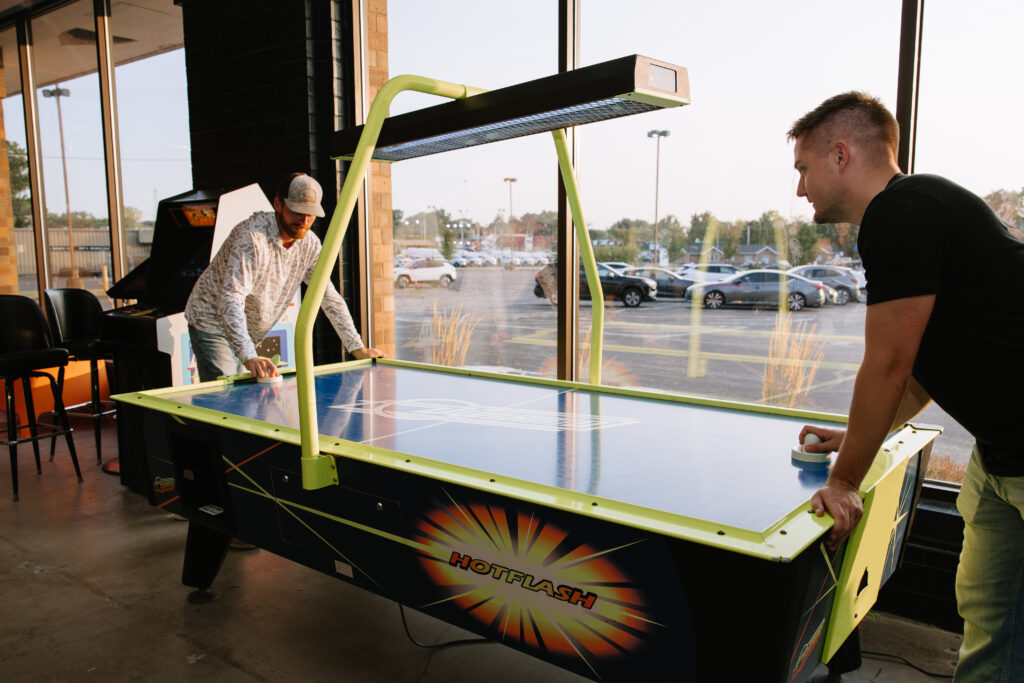
That loop of shoot, walk, score and repeat is the whole rhythm of the game. Here is how the shuffleboard table game rules work from the first shot to the last.
- Choose sides and a target score. Decide whether you are playing singles or doubles, then agree on 15 or 21 points before you throw.
- Flip a coin. The side that shoots first picks the color, which is why some winners choose to shoot second, as the next section explains.
- Brush on fresh powder. Sprinkle a light, even layer so the surface is consistent for both sides.
- Slide one weight at a time. Release each weight by hand from behind the foul line, then let your opponent shoot.
- Finish all eight weights. Once every weight is shot, a round is complete.
- Check the board before touching anything. Both players look at the far end and agree on the score, and nobody moves a weight until they do.
- Score and switch ends. Record the points, then play the next round starting from the end where you now stand.
In singles, both players stand at the same end and walk to the other end together after each round. That walk is part of the charm. It gives you a moment to trash-talk a lucky hanger or admire a clean shot before the next round starts.
Who Shoots First, and What Is the Hammer?
A coin toss decides who shoots first in the opening round. The side that shoots last in a round has the hammer, which is the final shot. That shot is an advantage because you get the last chance to knock an opponent’s weight away or protect your own.
Because the hammer is so useful, the winner of the coin toss often chooses to shoot second, which gives them the last shot. In later rounds, the side that scored in the previous round usually shoots first. That makes scoring a small trade, since you gain points but give up the last shot.
How Does Doubles Shuffleboard Work?
In doubles, each team puts one player at each end of the table, and each player stays at that end for the whole game. The two players at one end shoot a round, then the two at the other end shoot the next. Whoever is at the far end reads the board and records the score.
Doubles is where table shuffleboard gets social. Your partner can call the position from the other end, point out a weight you cannot see, and share the blame when a shot sails off the edge. Four players is also the easiest way to keep a group moving, since half the group is always ready to shoot.
How Do You Score Shuffleboard?
Shuffleboard scoring works by zone. A weight that stays on the table is worth 1, 2 or 3 points, depending on how far past the lines it stops, and a weight hanging over the end earns 4. After all eight shots, only the side with the farthest weight scores, and only for weights ahead of the opponent’s best.
| Where the weight stops | Points |
|---|---|
| Past the foul line but not fully past the 2 line | 1 |
| Fully past the 2 line but not fully past the 3 line | 2 |
| Fully past the 3 line, still on the table | 3 |
| Hanging over the end of the table | 4 (a hanger) |
| Short of the foul line, or off the table | 0 |
Source: Shuffleboard Federation rules for table shuffleboard.
These table shuffleboard scoring rules look simple, but the second half of the rule does the heavy lifting. Only one side scores per round, so a weight in the 3 zone is worth nothing if the other side has a weight deeper than it.
What Is a Hanger in Shuffleboard?
A hanger is a weight that stops with part of it extending past the end of the table without falling. A hanger is worth 4 points under standard rules, one more than the 3 zone. It stays valid only if it is still hanging when the round is scored.
If a hanging weight drops off before scoring, it counts as dead. Many players agree to push a hanger back onto the table once it is scored, which is a common courtesy. To settle whether a weight really hangs, lay another weight flat against the end and slide it along the edge. If it bumps the disputed weight, the weight is a hanger.
What If a Weight Touches a Line?
A weight that touches a line scores only the lower zone. To earn a higher zone, the whole weight must be past the line, with no part resting on it. A weight that touches the foul line is out of play in many rule sets.
The fairest way to judge is to look straight down at the weight. If you can see a sliver of wood between the weight and the line, it is clear. Do not shake the table or move any weight while you look, because bumping the board can change the result.
How Do You Score One Round? A Worked Example
The easiest way to learn shuffleboard scoring is to walk through one round. Imagine red and blue each shoot four weights, and this is where they stop.
| Side | Where the weights stopped |
|---|---|
| Red | One hanger, one in the 3 zone, one in the 1 zone, one off the table |
| Blue | One in the 2 zone, one in the 1 zone, two off the table |
- Red owns the farthest weight, the hanger, so only red can score this round.
- Find blue’s best weight. It is the weight in the 2 zone.
- Count each red weight that sits ahead of that blue weight: the hanger (4) and the 3 zone weight (3).
- Red’s weight in the 1 zone is behind blue’s best weight, so it does not count.
Red scores 7 points, blue scores 0, and red shoots first in the next round. Notice that blue’s two weights stayed on the table and still earned nothing. That surprises many first-time players and explains why knocking an opponent’s best weight away matters so much.
What Happens When the Leading Weights Tie?
When the leading weights of both colors are impossible to separate, a common rule is that nobody scores that round. Ties between two weights of the same color are different, since both can count if they are ahead of the opponent’s best weight. Look straight down at the weights to make the call.
How Many Points Do You Play To?
Most table shuffleboard games are played to 15 points, which is the official tournament target, or to 21 points in many casual and doubles games. The first side to reach the target wins. There is usually no win-by-two rule and no busting, so the game simply ends when someone gets there.
Agree on the target before the first coin toss. A game to 15 moves quickly and suits a busy night, while a game to 21 gives a comeback more room to happen.
What Counts as a Foul in Bar Shuffleboard?
A foul in bar shuffleboard is any move that gives a player an unfair advantage, such as shaking the table, touching a weight during a round, or shooting out of turn. Penalties vary by rule set, but the usual result is that a weight is removed, a shot is replayed, or a point is lost.
- Shaking or bumping the table: do not lean hard or move the table while a weight is in motion. League-style rules may take a point.
- Touching the playing surface: rest a hand on the cradle if you need support, but keep it off the board.
- Holding extra weights: keep other weights in the trough and hold only the one you are about to shoot.
- Shooting before the last weight stops: wait until the previous weight is fully still.
- Moving weights before the score is agreed: nobody touches the board until both players have viewed it.
What Happens If a Player Shoots the Wrong Color Weight?
If you shoot a weight of the wrong color, the usual casual fix is to swap in the correct weight before play continues. In strict tournament play, the shot is a foul and the weight is removed. Settle your approach early, because colors cannot be switched once a game has started.
Here are common situations and how most players rule on them.
| Situation | Common ruling |
|---|---|
| A weight falls off the table | It is dead, even if it bounces back |
| A weight stops short of the foul line | It is removed so it does not block the next shot |
| A weight flips over | It stays in play, so turn it upright |
| You knock a moving weight off the table | The other weight is put back, and yours is removed |
| A hanger drops before scoring | It is dead and scores nothing |
Which Bar Shuffleboard Rules Should You Agree On Before the First Shot?
Bar shuffleboard rules vary from table to table, so settle six things before the first shot: the winning score, which foul line counts, how to treat hangers, who shoots first next round, what a tied round means, and whether shots have a time limit. A 30 second chat prevents most arguments.
| Question to settle | Common options |
|---|---|
| What is the winning score? | 15 points or 21 points |
| Which foul line counts? | The long line for casual play, the short line for tournament play |
| Are hangers pushed back after scoring? | Yes, as a courtesy, or they stay as they are |
| Who shoots first next round? | The side that scored, or alternate |
| What happens in a tied round? | No score, then follow the normal order |
| Is there a time limit per shot? | None in casual play, about 30 seconds in tournaments |
What Other Games Can You Play on a Shuffleboard Table?
A shuffleboard table can host several games. Knock Off is the standard game explained above, and Horse Collar, Crazy Eights, Tap and Draw, Three Strikes and Target change how weights are shot or scored. They keep a long night interesting when the same group plays for hours.
| Game | How it differs from Knock Off |
|---|---|
| Horse Collar | Played to 51 points, with hangers worth 13 and corner hangers worth 26 |
| Crazy Eights | A player shoots four weights, then tries to knock them all off with four more while keeping one on the table |
| Tap and Draw | You may tap your own weight forward, but knocking an opponent’s weight off sends it back |
| Three Strikes | Each shooter beats the previous score, and one weight acts as a multiplier |
| Target | A target of rings replaces the zones, with up to 5 points |
Source: published rules for each game. House versions often change small details.
If you only learn one, learn Knock Off. It is the game most people mean when they say they are playing shuffleboard at a bar, and everything above applies to it directly.
How Do You Get Better at Table Shuffleboard?
To get better at table shuffleboard, practice a soft, steady slide, control your speed before your aim, and use your weights to block and protect as well as to score. A slow, repeatable motion beats a hard throw almost every time, because the powder rewards smooth releases. The best moment in the game is quiet: a weight creeping toward the edge while everyone holds their breath.
- Use a light grip: hold the weight with your thumb on one side, your index finger on top and your middle finger on the other side.
- Let it float: aim to float the weight to the end, not hurl it.
- Pick a landing spot: aim at a point on the table so you can compare shots from round to round.
- Spread your weights out: weights that sit apart are harder to knock away in one shot.
- Protect your best weight: park a second weight in front of or beside it as a blocker.
- Save your hammer: use the last shot to remove your opponent’s best weight.
Should You Go for the Hanger Every Time?
No. A hanger is worth 4 points, but it is also the riskiest shot, since a slightly firm slide drops the weight off the table. Take the hanger when you have the hammer or when the round is close. Otherwise, a safe weight in the 3 zone is worth nearly as much.
Where Can You Play Bar Games Near St. Charles, MO?
Bar games are found at bars, game rooms and entertainment venues all around the metro area. Rec Hall is a 33,000 square foot venue in St. Charles, Missouri, with an arcade, yard games, Zero Latency VR and a full bar.
Call (314) 818-0916 to ask whether a shuffleboard table is out on the floor before you visit.
Not sure what else is on the floor? The game night ideas near St. Louis page shows how groups plan a full evening. Anyone who likes a pub-style game can also look at bars with games near O’Fallon, MO.
What Are Rec Hall’s Hours?
Rec Hall is open Thursday to Sunday and closed Monday to Wednesday. Here are the hours:
- Thursday: 5 PM to midnight.
- Friday: 5 PM to midnight.
- Saturday: noon to midnight.
- Sunday: noon to 7 PM.
Who Can Visit Rec Hall?
Guests of all ages are welcome until 5 PM on Saturday and all day on Sunday. Rec Hall is 18 and older on Thursday, Friday and Saturday after 5 PM. See the FAQs and the general admission page for details.
What Other Games Can You Try Next?
If you enjoy sliding and aiming games, these guides cover good next steps:
- Cornhole: learn the cornhole rules and scoring.
- Skee-Ball: read how to play skee ball for higher scores.
- Pool: compare the 8 ball rules and the 9 ball rules for a classic bar game night.
- Yard games: browse yard games for adults.
Can You Book a Group for Game Night?
Yes. Rec Hall hosts groups of all sizes, up to 800 guests, through private events at Rec Hall and corporate events at Rec Hall. Check the Rec Hall events calendar first, because private events can close the venue to the public.
Ready to Play? Start Here at Rec Hall
Now that you know the shuffleboard rules, put them to use with a group. Read our guide to where to play pool near me, look at the Rec Hall menu for food and drinks, or send your group details through book your event. Questions first? Call (314) 818-0916 or use the Rec Hall contact page.
Frequently asked questions
What are the basic rules of shuffleboard?
Two sides take turns sliding four weights each down the table. After all eight are shot, only the side with the farthest weight scores. First to 15 or 21 wins.
How do you play shuffle board?
Flip a coin, then alternate sliding one weight at a time toward the far end. After eight shots, agree on the score and play on from the other end.
How do you score shuffleboard?
Weights score 1, 2 or 3 points by zone, and a hanger scores 4. Only the side with the farthest weight scores, counting weights ahead of the opponent’s best.
How do you play shuffleboard for beginners?
Learn the zones first, agree on a target score, and practice sliding to the 2 zone. Add blocking and knock-off shots once your speed control feels steady.
What is the shuffleboard game and how does it work?
Shuffleboard is a sliding game where players push weighted discs toward scoring zones. Table shuffleboard is played by hand on a long wooden table, usually at bars and game rooms.
Can you bust in shuffleboard?
No. Table shuffleboard usually has no busting, so the game ends once a side reaches the target score. Some house rules add a win-by-two condition, so ask first.
What is a hanger in shuffleboard?
A hanger is a weight that stops with part of it over the end of the table without falling. It scores 4 points if it is still there at scoring.
How many points do you play to in table shuffleboard?
Official tournament games go to 15 points. Many casual and doubles games go to 21. Agree on the target before the first shot.
What does the hammer mean in shuffleboard?
The hammer is the last shot of a round. It is an advantage because you get the final chance to knock away an opponent’s weight or protect your own.
What happens if a weight touches a line?
It scores only the lower zone, since the whole weight must pass a line to earn the higher zone. A weight touching the foul line is often out of play.
What is the difference between table and deck shuffleboard?
Table shuffleboard is slid by hand on a wooden table with 1 to 4 point zones. Deck shuffleboard uses cues on a court with a 10, 8 and 7 triangle.
Does Rec Hall have a shuffleboard table?
Rec Hall has an arcade, yard games, free-roam VR and a full bar. Call (314) 818-0916 to ask whether a shuffleboard table is out on the floor.
What are Rec Hall’s hours?
Thursday and Friday 5 PM to midnight, Saturday noon to midnight, and Sunday noon to 7 PM. Rec Hall is closed Monday to Wednesday.
About the Rec Hall Team
Rec Hall is a 33,000 square foot entertainment venue at 800 South Duchesne Drive in St. Charles, Missouri, with arcade games, yard games, Zero Latency VR and a full bar. Guests rate it 4.6 out of 5 from 820 Google reviews. Learn more about Rec Hall or read what is a rec hall.